
Why B2B Manufacturers Need a Point of View to Win the Modern Buyer Journey
IB2B manufacturers face a massive trust gap with AI. While AI adoption for supplier research has nearly doubled, average trust in its output remains low at 4.9/10. Consequently, 81% of buyers establish vendor shortlists incognito before ever contacting a vendor, and 34% of buying cycles now exceed 12 months.
To cut through the AI-generated noise, manufacturers must pivot to authoritative thought leadership rooted in a unique Point of View (POV), that is, a market perspective that reflects their distinct strengths. RH Blake research proves the commercial impact: 87% of buyers view POV-driven organizations more positively, 82% contact them first, and 76% are more likely to pay a premium. Successful thought leadership must move upstream in the buyer journey to frame buyer challenges early. This requires technically rigorous, scannable assets that address modern triggers, such as asset aging (77%) and integration complexity (46%) to earn the trust that generic AI content cannot.
——
Today’s B2B manufacturers are facing a paradox. There is more information available than ever before, yet buyers have never felt more overwhelmed or skeptical. The rise of generative AI has created a firehose of content that often lacks depth, leading to a significant trust gap. For manufacturers selling complex, high-capital solutions with long sales cycles, the traditional me-too marketing approach is no longer sufficient. To cut through the noise, organizations must pivot from general content to authoritative thought leadership rooted in a unique Point of View (POV).
Free Download: 5 Key Steps to Developing a Digital Marketing Roadmap
A Must Have Digital Marketing Guide for Manufacturers
The Invisible Buyer and the Lengthy Journey
The modern manufacturing buying journey has moved largely underground. The 2026 B2B Manufacturing Buying Journey & Thought Leadership Research indicates that 81% of buyers now establish a vendor shortlist before ever making contact. This incognito research phase is driven by a desire for digital self-education, with the vendor website serving as the primary commercial hub for 37% of buyers at the start of their journey and 83% throughout the entire process.
The complexity of these decisions is also intensifying. In 2026, 34% of buying cycles lasted 12 months or longer, a massive increase from just 13.7% in 2024. These decisions are rarely made in isolation; roughly 83% of purchases involve committees of five or more evaluators, encompassing roles from engineering and operations to finance and IT. In this environment, generic product descriptions fail to address the diverse technical, financial, and operational concerns of the buying unit.
The AI Paradox: Surging Adoption, Crashing Trust
AI has fundamentally altered how industrial buyers surface information. Adoption of AI as a research tool surged from 23% in 2024 to 48% in 2026. But this adoption has not been met with confidence. The average trust score for AI-generated output is a meager 4.9 out of 10, with 21% of respondents rating their trust at the lowest possible levels.
Because buyers are skeptical of AI’s reliability, they are increasingly verifying claims through human-verified, technical data and independent sources. In fact, 69% of buyers turn to sales representatives specifically to validate insights generated by AI. This creates a massive opportunity for manufacturers who can provide a human-verified perspective that AI cannot replicate: a distinct Point of View.
Defining Point of View in the Age of AI
A Point of View is not merely a product vision or a roadmap. While a vision describes what a product will eventually become, a POV is a perspective on the future of the market itself. It reflects the underlying assumptions a company uses to make strategic choices and encapsulates an opinion on what good solutions look like in a changing space.
For a manufacturer, a strong POV should be rooted in distinct strengths, such as what the organization can do better than any other vendor in the market. It is the authoritative-consultant stance that helps a buyer frame their own challenges and establish evaluation criteria long before they are ready to buy.
The Measurable Value of a Unique Perspective
The financial and strategic impact of high-quality thought leadership with a decisive viewpoint is supported by two major RH Blake studies.
Insight from the RH Blake Buying Journey Report
- 87% of buyers think more positively about an organization that produces high-quality thought leadership
- 82% will contact that organization first when a need arises
- 76% of buyers state that quality content influences whether a vendor is invited to the RFP process
Insight from the RH Blake Thought Leadership Study
- 90% of decision-makers are more likely to consider buying from an organization that produces thought leadership
- 84% of C-level executives have actually purchased or started working with a vendor specifically because of their thought leadership
- Perhaps most importantly for margins, 76% of decision-makers are more likely to pay a premium to work with an organization that demonstrates this level of authority
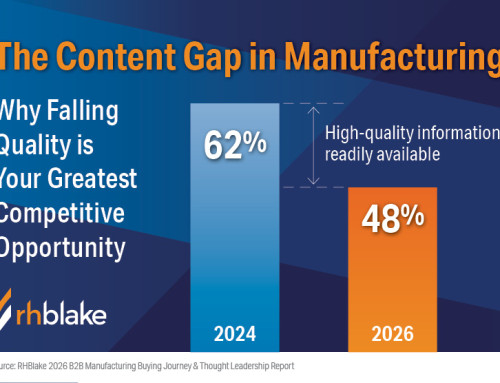
Despite these clear benefits, there is a widening content gap. In 2024, 62% of buyers felt there was enough quality information in the market; by 2026, that number plummeted to 48%. While 90% of buyers continue to consume thought leadership for their professional roles, they are increasingly dissatisfied with the generic, unbiased, or boastful content currently available.
B2B Manufacturing Challenges: Triggers for a POV
To be effective, a manufacturer’s POV must align with the compelling events that force buyers to act. Triggers for starting a journey have shifted away from general efficiency toward risk management and modernization. Asset aging (77%) and capacity expansion (76%) are now the top drivers for new purchases. Additionally, safety and risk management triggers have grown by 32 percentage points, while regulatory compliance triggers have grown by 27 points.
A manufacturer who publishes a POV on The Future of Resilient Infrastructure in Aging Plants addresses these triggers directly. Instead of just selling a replacement part, they are framing the problem of asset obsolescence and helping the buyer build criteria for long-term reliability.
Another critical gap is integration complexity, which has seen the fastest growth among buyer concerns, jumping 19 percentage points to become a primary concern for 46% of buyers. Most vendors routinely overlook integration requirements in their marketing materials. A manufacturer who takes a decisive stand on Integration-First Architecture provides the technical proof and deployment reality that buyers are starving for.
Examples of Point of View in the Market
To understand how to articulate a POV, consider how leading industrial firms differentiate themselves based on their unique strengths.
- Grainger built its “Know How” content hub around a clear stance: that the real value isn’t the product catalog, it’s operational expertise that helps maintenance and facilities teams solve problems before they become downtime. The POV is essentially, “we understand your job better than a parts supplier should,” which justifies why a distributor publishes deep technical content instead of just SKUs.
- Festo has long taken the position that automation isn’t just a hardware problem but a workforce and education problem. Their Festo Didactic arm and content consistently argue that the bottleneck in manufacturing isn’t technology, but skills transfer. That’s a contrarian-enough stance (most competitors pitch faster/smarter machines) that it gives their thought leadership a recognizable spine.
- Rockwell Automation has pushed a consistent argument that IT/OT convergence is inevitable and that manufacturers who treat cybersecurity, data, and automation as separate functions will lose competitively. Their content (State of Smart Manufacturing reports, executive bylines) keeps returning to that same thesis rather than just covering trends generically.
Notice the pattern? Each of these companies picked one belief about how the industry should work and stayed disciplined about returning to it across formats, rather than chasing whatever topic was trending that month. That repetition is what turns content into a recognizable point of view instead of just “stuff we published.”
Some other examples would be a pump manufacturer arguing that Connectivity is secondary to Mechanical Resilience, or a robotics firm stating that Adaptive Safety is the only path to True Human-Robot Collaboration. As you can see, these are not just product claims. They are beliefs about the future of the industry that help a buyer decide if they want to take the trip with that vendor.
How Manufacturers Can Win the Invisible Stages
To turn a unique POV into a competitive advantage, manufacturers must follow a system of evidence-based asset creation.
- Move Upstream: Use thought leadership to help buyers name and frame their problems during the awareness stage. 80% of buyers now use thought leadership at the start of their journey to define evaluation criteria.
- Focus on Technical Proof: Buyers prioritize real-world experiences, case studies (4.41/5 importance), and strong research data (4.00/5) over brand prestige or award-boasting. To counter AI skepticism, provide precise, structured data that AI tools can accurately index and summarize.
- Design for the Committee: Don’t create single, broad whitepapers. Map content to specific personas. Provide TCO and lifecycle cost frameworks for Finance, while giving integration guides and technical specs to Engineering.
- Prioritize Scannability: 50% of buyers now spend two hours or less per week on research, a massive shift from 2024 when research windows were longer. Lead with Too Long; Didn’t Read (TL/DR) summaries, visual data, and shareable pull quotes that can travel through peer networks and LinkedIn.
- Be Transparent about Integration: Address the deployment realities that others ignore. Provide honest documentation of failures, lessons learned, and pricing transparency to earn the trust that AI-generated content often loses.
Conclusion: From Vendor to Authoritative Consultant
The future of B2B manufacturing marketing belongs to the authoritative consultant, not the loudest brand. In an era where AI can generate infinite amounts of generic information, the only way to earn trust is to provide a unique, human-verified perspective grounded in real-world expertise.
By focusing on problem-framing, technical proof, and a decisive Point of View, manufacturers can bridge the trust gap and turn the current content deficit into a lasting competitive advantage. When you help your market learn something new and valuable, you open doors, influence RFPs, and earn the right to lead the industrial landscape of tomorrow.

"You guys met our expectations in every way. It [RH Blake Market Research] was the information we were looking for. Congratulations and Thank You!"
 Scott Griggs
Director of Services for Food Manufacturing and Food Service
ALS Global

"“I’ve gotten all that I’d hoped for from the RH Blake Growth Roadmap™ and more. Based on the research and insights, we adjusted our offering scope and sales approach. And this adjustment has been effective at generating new opportunities."
 Diane Reko
President
REKO International

"RH Blake has been an outstanding partner. They deliver creativity, on time, and always so professional. We love working with them because of their perspective, support, and their efficiency in turning projects around quickly."
 Samantha Spano
Digital Product Marketing & Communications Manager
Industrial Automation Energy Industries
ABB
"You guys met our expectations in every way. It [RH Blake Market Research] was the information we were looking for. Congratulations and Thank You!"
Scott Griggs
Director of Services for Food Manufacturing and Food Service
ALS Global
"“I’ve gotten all that I’d hoped for from the RH Blake Growth Roadmap™ and more. Based on the research and insights, we adjusted our offering scope and sales approach. And this adjustment has been effective at generating new opportunities."
Diane Reko
President
REKO International
"RH Blake has been an outstanding partner. They deliver creativity, on time, and always so professional. We love working with them because of their perspective, support, and their efficiency in turning projects around quickly."
Samantha Spano
Digital Product Marketing & Communications Manager
Industrial Automation Energy Industries
ABB
"You guys met our expectations in every way. It [RH Blake Market Research] was the information we were looking for. Congratulations and Thank You!"
Scott Griggs
Director of Services for Food Manufacturing and Food Service
ALS Global
"“I’ve gotten all that I’d hoped for from the RH Blake Growth Roadmap™ and more. Based on the research and insights, we adjusted our offering scope and sales approach. And this adjustment has been effective at generating new opportunities."
Diane Reko
President
REKO International
"RH Blake has been an outstanding partner. They deliver creativity, on time, and always so professional. We love working with them because of their perspective, support, and their efficiency in turning projects around quickly."
Samantha Spano
Digital Product Marketing & Communications Manager
Industrial Automation Energy Industries
ABB
Industrial Marketer’s Guide to Creating an Effective Marketing Program
147 pages of actionable ideas to help you create a winning marketing strategy and program
Industrial Marketer’s Guide to Creating an Effective Marketing Program
147 pages of actionable ideas to help you create a winning marketing strategy and program
Related Clients