
Thought Leadership Has Moved Upstream in the Manufacturing Buyer Journey
The New Rule for B2B Manufacturing Markets
Are you waiting for an RFP to prove your expertise? If you are, you have likely already lost the deal.
The common wisdom for years has been that thought leadership’s primary job was to validate a buyer’s choice at the end of the journey—the final proof before a contract was signed.
Today, in complex manufacturing markets, the traditional sales funnel is far less predictable. Buyers are forming opinions, building vendor shortlists, and defining evaluation criteria long before they speak with sales.
You can’t afford to wait for an RFP to know that you are on a prospect’s radar. The B2B Manufacturing Buying Journey & Thought Leadership Report 2026 from RH Blake reveals the new reality. Thought leadership has moved upstream, shaping problems, not just resolving them.
The Great Migration Upstream
Many industrial buyers are not simply looking for product information. They are looking for expert guidance that helps them understand their problem, compare possible solutions, and build confidence before they involve vendors directly.
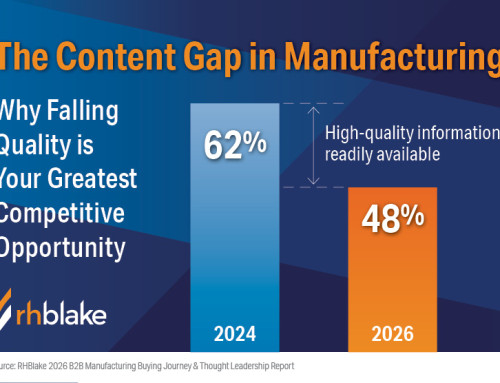
The data paints a startling picture of this shift. Since 2024, the reliance on thought leadership during the Awareness stage has spiked to 80%. Conversely, the use of this content during the Decision stage has fallen from 72% down to just 48%.
Free Download: 5 Key Steps to Developing a Digital Marketing Roadmap
A Must Have Digital Marketing Guide for Manufacturers
Why is this happening? Because 81% of buyers now have already drafted a vendor shortlist before they ever contact a vendor. If you aren’t using your thought leadership content to frame the challenge during the first 25% of the buyer’s journey, you simply won’t be on the list when your prospect starts inviting vendors to bid. Buyers are conducting research incognito, using vendor websites as their primary commercial tool to build evaluation criteria without your sales team’s input.
Why Problem-Shaping is the New Competitive Advantage
In a market where 83% of purchases involve committees of five or more stakeholders, the person who defines the problem wins the project. When you move upstream, you stop competing on price and start competing on perspective.
The report highlights that 71% of respondents find thought leadership more trustworthy than traditional sales and marketing materials. Buyers use this high-quality content to navigate lengthening buying cycles (which have seen a massive increase, with 34% of deals now taking over 12 months to close). They are looking for problem-framing and solution-based content that helps them justify CAPEX for modernization, aging asset replacement, or regulatory compliance.
Expanding the Key Action Steps: How to Win Upstream
To thrive in this new industrial reality, you must evolve from a product or service provider into an authoritative consultant. Here is how you execute the Upstream strategy in full detail:
1. Define the Problem Before They Do
You must help buyers frame and name their challenges before they can even articulate a solution. Most vendors wait for a lead to say, “We need X.” The upstream thought leader publishes content that says, “You are likely experiencing Y because of Z, and here is the hidden cost of ignoring it.” By naming the pain, you become the natural owner of the cure.
2. Shape the Evaluation Criteria
Don’t just list your features. Highlight the tradeoffs a buyer should consider. Use your thought leadership to build the yardstick by which all vendors—including your competitors—will be measured. When you help a buyer understand the importance of integration complexity or total cost of ownership early on, you ensure the RFP is written in a way that favors your strengths.
3. Create Category Vocabulary
Establish the language the buyer should use to describe their problem. If a buyer learns your vocabulary during the Awareness stage, they are significantly more likely to recognize and prefer your solution during the Consideration stage. This creates a locked-in effect where your expertise becomes the framework for their entire project.
4. Bridge the AI Trust Gap with Technical Proof
AI adds another layer to the upstream challenge. As more buyers use AI tools to summarize vendor options, compare claims, and accelerate early research, manufacturers need thought leadership that is technically specific, well-sourced, and easy for both humans and AI systems to interpret.
The research shows that, while AI adoption for research has nearly doubled to 48%, trust in AI output remains low, with an average score of just 4.9 out of 10. Upstream thought leadership must provide verifiable, technical data that survives the scrutiny of AI-assisted comparisons. You should lead with evidence, original research, and practitioner voices to satisfy the 90% of buyers who still consume thought leadership for their professional roles.
The Commercial Reality
You must appreciate that this thought leadership isn’t about building brand awareness. It’s about creating measurable commercial outcomes. Organizations that consistently produce high-quality, upstream thought leadership see meaningful impact. Around 87% of buyers think more positively about these organizations, 82% will contact them first, and 76% say this quality of content directly influences an invitation to the RFP process.
This insight, that thought leadership has moved upstream, is just one of 13 critical insights found in the B2B Manufacturing Buying Journey & Thought Leadership Report 2026 from RH Blake. The window to make an impact is shrinking, as 50% of buyers now spend two hours or less per week on research. You cannot afford to wait until the end of the journey to make your case.
The companies that influence the early stages of the buying journey have a stronger chance of being recognized, trusted, and shortlisted before the formal sales process begins.

"You guys met our expectations in every way. It [RH Blake Market Research] was the information we were looking for. Congratulations and Thank You!"
 Scott Griggs
Director of Services for Food Manufacturing and Food Service
ALS Global

"“I’ve gotten all that I’d hoped for from the RH Blake Growth Roadmap™ and more. Based on the research and insights, we adjusted our offering scope and sales approach. And this adjustment has been effective at generating new opportunities."
 Diane Reko
President
REKO International

"RH Blake has been an outstanding partner. They deliver creativity, on time, and always so professional. We love working with them because of their perspective, support, and their efficiency in turning projects around quickly."
 Samantha Spano
Digital Product Marketing & Communications Manager
Industrial Automation Energy Industries
ABB
"You guys met our expectations in every way. It [RH Blake Market Research] was the information we were looking for. Congratulations and Thank You!"
Scott Griggs
Director of Services for Food Manufacturing and Food Service
ALS Global
"“I’ve gotten all that I’d hoped for from the RH Blake Growth Roadmap™ and more. Based on the research and insights, we adjusted our offering scope and sales approach. And this adjustment has been effective at generating new opportunities."
Diane Reko
President
REKO International
"RH Blake has been an outstanding partner. They deliver creativity, on time, and always so professional. We love working with them because of their perspective, support, and their efficiency in turning projects around quickly."
Samantha Spano
Digital Product Marketing & Communications Manager
Industrial Automation Energy Industries
ABB
"You guys met our expectations in every way. It [RH Blake Market Research] was the information we were looking for. Congratulations and Thank You!"
Scott Griggs
Director of Services for Food Manufacturing and Food Service
ALS Global
"“I’ve gotten all that I’d hoped for from the RH Blake Growth Roadmap™ and more. Based on the research and insights, we adjusted our offering scope and sales approach. And this adjustment has been effective at generating new opportunities."
Diane Reko
President
REKO International
"RH Blake has been an outstanding partner. They deliver creativity, on time, and always so professional. We love working with them because of their perspective, support, and their efficiency in turning projects around quickly."
Samantha Spano
Digital Product Marketing & Communications Manager
Industrial Automation Energy Industries
ABB
Industrial Marketer’s Guide to Creating an Effective Marketing Program
147 pages of actionable ideas to help you create a winning marketing strategy and program
Industrial Marketer’s Guide to Creating an Effective Marketing Program
147 pages of actionable ideas to help you create a winning marketing strategy and program
Related Clients