
Manufacturing Lead Generation for Complex, Long-Sales-Cycle Products
The lead is a milestone in a longer process
RHBlake’s research shows only 19% of buyers contact a vendor in the first 10% of the journey. A buyer may already know the problem, understand several technologies, and have a short list before appearing in the CRM. Lead generation therefore includes the content and visibility that made the supplier worth contacting.
Build visibility around the problem the buyer is trying to solve
Manufacturing buyers often begin with a trigger or application problem. Build visibility around modernization, compliance, capacity, integration, reliability, cost, performance, and other situations that create demand. Category keywords matter, but they are only one layer of the search journey.
Create conversion options for different stages
A late-stage buyer may request a quote. An earlier buyer may want a design guide, comparison, case study, webinar, calculator, or research report. Matching the conversion to the stage improves usefulness and gives marketing more meaningful intent data.
Use proof to improve lead quality
Technical specificity and differentiation help serious buyers self-qualify. Application detail, constraints, examples, certifications, integration guidance, and service information can reduce low-fit inquiries while increasing confidence among high-fit accounts.
Free Download: 5 Key Steps to Developing a Digital Marketing Roadmap
A Must Have Digital Marketing Guide for Manufacturers
Close the feedback loop with sales
Sales feedback is part of the system. Which inquiries were credible? Which objections kept coming back? Which applications attracted serious conversations? What evidence was missing? Marketing can use those answers to sharpen targeting and content so the program gets more precise over time.
Those outcomes are better understood as the result of a connected buyer pathway: search visibility, relevant content, clearer positioning, useful proof, and conversion opportunities working together over time. That is a more durable model than treating every campaign as an isolated source of leads.
Factivity and Elesa North America are useful because both demonstrate the cumulative nature of manufacturing lead generation. RHBlake reports more than 50% organic-traffic growth and 815% cumulative lead growth for Factivity, and 75% lead-generation growth plus an 8.3% conversion-rate improvement for Elesa.
Two RHBlake programs show what happens beyond the form fill
What this looks like in practice
A manufacturer can have plenty of ‘leads’ and still have a demand problem. If inquiries come from poor-fit applications, students, job seekers, or buyers with no commercial path, increasing the form count solves very little. Lead quality improves when the market story, search strategy, proof, and conversion path all point toward the situations where the company can actually win.
For complex manufacturers, qualified demand accumulates over time. Marketing has to be useful before the lead appears, disciplined about what it measures once intent becomes visible, and tightly connected to sales after the handoff.

"You guys met our expectations in every way. It [RH Blake Market Research] was the information we were looking for. Congratulations and Thank You!"
 Scott Griggs
Director of Services for Food Manufacturing and Food Service
ALS Global

"“I’ve gotten all that I’d hoped for from the RH Blake Growth Roadmap™ and more. Based on the research and insights, we adjusted our offering scope and sales approach. And this adjustment has been effective at generating new opportunities."
 Diane Reko
President
REKO International

"RH Blake has been an outstanding partner. They deliver creativity, on time, and always so professional. We love working with them because of their perspective, support, and their efficiency in turning projects around quickly."
 Samantha Spano
Digital Product Marketing & Communications Manager
Industrial Automation Energy Industries
ABB
"You guys met our expectations in every way. It [RH Blake Market Research] was the information we were looking for. Congratulations and Thank You!"
Scott Griggs
Director of Services for Food Manufacturing and Food Service
ALS Global
"“I’ve gotten all that I’d hoped for from the RH Blake Growth Roadmap™ and more. Based on the research and insights, we adjusted our offering scope and sales approach. And this adjustment has been effective at generating new opportunities."
Diane Reko
President
REKO International
"RH Blake has been an outstanding partner. They deliver creativity, on time, and always so professional. We love working with them because of their perspective, support, and their efficiency in turning projects around quickly."
Samantha Spano
Digital Product Marketing & Communications Manager
Industrial Automation Energy Industries
ABB
"You guys met our expectations in every way. It [RH Blake Market Research] was the information we were looking for. Congratulations and Thank You!"
Scott Griggs
Director of Services for Food Manufacturing and Food Service
ALS Global
"“I’ve gotten all that I’d hoped for from the RH Blake Growth Roadmap™ and more. Based on the research and insights, we adjusted our offering scope and sales approach. And this adjustment has been effective at generating new opportunities."
Diane Reko
President
REKO International
"RH Blake has been an outstanding partner. They deliver creativity, on time, and always so professional. We love working with them because of their perspective, support, and their efficiency in turning projects around quickly."
Samantha Spano
Digital Product Marketing & Communications Manager
Industrial Automation Energy Industries
ABB
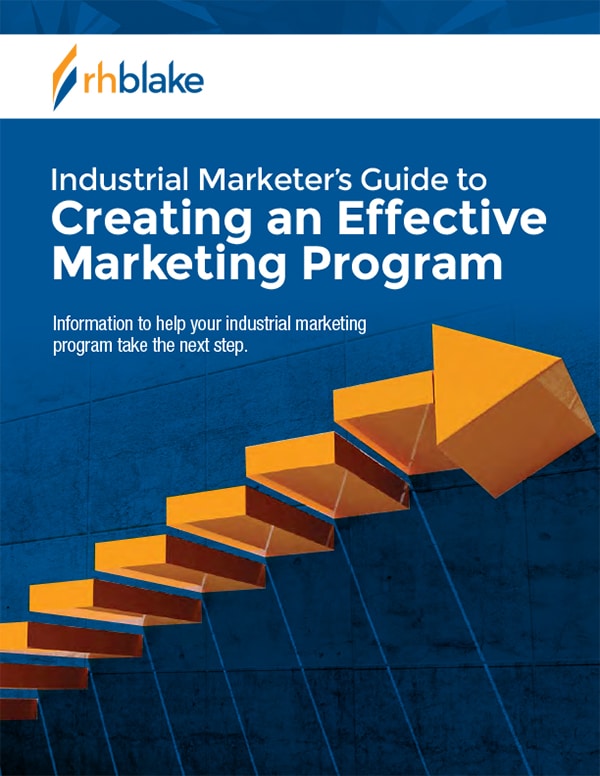
Industrial Marketer’s Guide to Creating an Effective Marketing Program
147 pages of actionable ideas to help you create a winning marketing strategy and program
Industrial Marketer’s Guide to Creating an Effective Marketing Program
147 pages of actionable ideas to help you create a winning marketing strategy and program
Related Clients