
Buyer-Insight Growth in B2B Manufacturing
Manufacturing marketers are facing a relevance, trust, and differentiation challenge. RH Blake research shows that 81% of buyers establish a vendor shortlist before first contact, while 64% choose to speak with someone at a company within the first quarter of the buying journey. Perceived thought leadership quality has also fallen from 62% in 2024 to 48% in 2026, even as 90% of buyers still rely on thought leadership in their professional roles. The opportunity is to build marketing around a buyer insight your company can own, prove, and repeat across the full journey.
For years, B2B manufacturing marketing has been organized around activity. Build the editorial calendar. Answer the search questions. Publish the blog. Promote the webinar. Capture the lead. Nurture the prospect. Measure the conversion.
That model still has value. Buyers still search. Content still supports discovery. Email still helps nurture demand. In complex industrial markets, activity alone rarely creates enough preference. A manufacturer can be visible, useful, and technically accurate and still fail to make the shortlist.
The companies gaining an advantage use marketing to help buyers understand what is changing, why it matters, and how to make a better decision. They build from content volume into buyer-insight growth.
Buyer-insight growth starts with a sharper question: What do we know about our customers, applications, risks, tradeoffs, or markets that helps buyers see the problem more clearly than they could before?
Free Download: 5 Key Steps to Developing a Digital Marketing Roadmap
A Must Have Digital Marketing Guide for Manufacturers
Why the Manufacturing Buyer Has Become Harder to Influence
The most important part of the manufacturing buyer journey often happens before a supplier knows the opportunity exists. RH Blake research shows that 81% of buyers establish a shortlist of vendors before they ever make first contact. That means the decisive work of creating awareness, shaping criteria, and building trust happens while the buyer is still invisible.
This is especially challenging in manufacturing because buyers are evaluating uptime risk, compatibility, lifecycle cost, production continuity, compliance, support, and internal approval. A technically correct article may answer a question without reducing the perceived risk of change.
Many buyers still engage early, often after substantial independent research and shortlist formation. In that environment, marketing serves as a lead-generation engine and the first technical, strategic, and credibility test your company must pass.
Helpful Content Is Now Table Stakes
The old content standard was usefulness. If a company answered a buyer question, it had a chance to earn traffic and attention. Usefulness alone rarely creates differentiation. In many industrial categories, buyers can find a dozen versions of the same explanation, comparison, checklist, or trend summary.
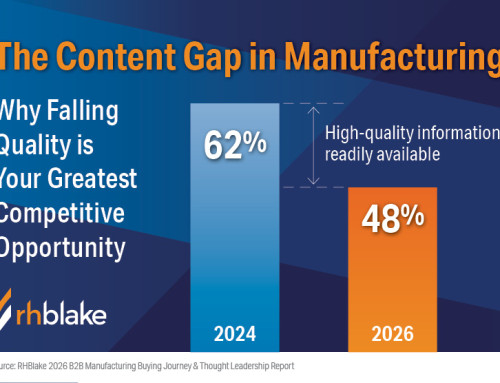
The quality gap is widening. In 2024, 62% of buyers felt there was sufficient high-quality thought leadership in their industry. By 2026, that number had fallen to 48%. Buyers are surrounded by content. They are still looking for perspective.
That creates a clear opening for manufacturers with real expertise. Ninety percent of buyers still consume thought leadership to help them perform their professional roles. The demand for guidance remains strong. Buyers are rejecting generic, interchangeable content that does little to help them make a more confident decision.
Building Buyer-Insight Growth
| Common Content Habits | Buyer-Insight Growth Practices |
|---|---|
| Start with keywords and topic gaps | Start with buyer tension, risk, and decision barriers |
| Answer known questions | Reframe the problem buyers are trying to solve |
| Measure visibility and lead capture | Measure shortlist influence, trust, and sales usefulness |
| Produce stand-alone assets | Build a connected point of view across the journey |
| Explain capabilities | Prove why the company sees the market differently |
| Support campaigns | Create a commercial asset sales can use in real conversations |
What Makes an Industrial Point of View Credible
A point of view is more than a tagline, campaign theme, or opinion dressed up as strategy. In industrial markets, it has to be grounded in evidence. The most credible perspectives are built from the places competitors cannot easily copy: voice-of-customer interviews, field experience, application knowledge, engineering tradeoffs, service data, customer outcomes, and original research.
This is where RH Blake’s approach is fundamentally different. We help manufacturers uncover the buyer insight that should shape how the market understands the problem, evaluates options, and builds confidence to act.
The strongest industrial perspectives usually connect three things:
- A real buyer tension: the operational, financial, technical, or organizational pressure that makes the status quo harder to defend.
- A differentiated belief: what your company believes buyers should do differently based on experience and proof.
- A credible evidence base: research, application examples, customer results, data, or expert commentary that supports the claim.
The Buying Committee Needs Shared Confidence
Modern manufacturing purchases are rarely made by one person. RH Blake research shows that 56% of purchases involve five or more evaluators, and 18% involve nine or more. Engineering may care about technical fit. Operations may care about uptime. Finance may care about total cost. IT may care about integration and cybersecurity. Leadership may care about strategic risk.
Generic content often fails because it speaks to one concern at a time. A strong buyer insight gives the committee a shared way to understand the decision. It creates language that helps internal champions explain the problem, justify action, and reduce perceived risk.
This is why thought leadership is most powerful when it moves upstream. If buyers learn how to frame the issue from you, they are more likely to use your criteria when they evaluate solutions.
AI Raises the Bar for Original Expertise
AI has made it easier to produce acceptable content. It has also made acceptable content less valuable. Buyers can quickly generate summaries, definitions, and comparison points. What they cannot easily generate is a trusted industrial perspective based on real-world experience.
RH Blake research shows that AI adoption for supplier research is rising while trust in AI output remains low. Buyers still look for verification through technical proof, case studies, expert interpretation, and data. The human and organizational expertise behind the content now carries greater strategic value.
For manufacturers, the advantage will come from using AI to accelerate execution while keeping the strategy rooted in original insight. The market needs clearer thinking from companies that know the consequences of getting the decision wrong.
How to Build a Buyer-Insight Growth System
This shift keeps content operations in place and gives them a stronger strategic center. A practical system includes five steps:
- 1. Mine the buyer journey. Use customer interviews, sales conversations, win/loss patterns, search behavior, and support questions to identify where buyers are confused, skeptical, or stuck.
- 2. Define the core problem thesis. Clarify the market condition or buyer mistake your company is uniquely qualified to explain.
- 3. Prove the thesis. Support the perspective with research, examples, expert commentary, data, and customer outcomes.
- 4. Translate it across awareness, preference, and trust. Use the same insight to guide educational content, comparison content, sales enablement, case stories, webinars, landing pages, and executive commentary.
- 5. Equip sales to use the insight. Turn thought leadership into conversation starters, objection-handling language, discovery questions, and buying committee tools.
The Commercial Value of Being the Clearest Voice
High-quality thought leadership builds reputation and changes buyer behavior. RH Blake research shows that 87% of buyers think more positively about an organization that produces high-quality thought leadership, 82% are more likely to contact that organization first when a need arises, 76% are likely to invite that organization into an RFP process, and 51% are willing to pay a premium to work with a firm that demonstrates this level of leadership.
For industrial companies, that is the real business case. The goal is to become the most trusted explanation of the problem your buyers need to solve.
When that happens, marketing becomes a compounding commercial asset. It helps buyers recognize the risk of inaction, understand what matters, align internal stakeholders, and choose with more confidence.
The Path Forward
Manufacturers need a clearer point of view, stronger proof, and a system for carrying that insight through the entire buyer journey.
The next stage of B2B manufacturing growth will belong to companies that educate and differentiate first by becoming the clearest, most credible, and most useful voice before the buyer ever reaches out.

"You guys met our expectations in every way. It [RH Blake Market Research] was the information we were looking for. Congratulations and Thank You!"
 Scott Griggs
Director of Services for Food Manufacturing and Food Service
ALS Global

"“I’ve gotten all that I’d hoped for from the RH Blake Growth Roadmap™ and more. Based on the research and insights, we adjusted our offering scope and sales approach. And this adjustment has been effective at generating new opportunities."
 Diane Reko
President
REKO International

"RH Blake has been an outstanding partner. They deliver creativity, on time, and always so professional. We love working with them because of their perspective, support, and their efficiency in turning projects around quickly."
 Samantha Spano
Digital Product Marketing & Communications Manager
Industrial Automation Energy Industries
ABB
"You guys met our expectations in every way. It [RH Blake Market Research] was the information we were looking for. Congratulations and Thank You!"
Scott Griggs
Director of Services for Food Manufacturing and Food Service
ALS Global
"“I’ve gotten all that I’d hoped for from the RH Blake Growth Roadmap™ and more. Based on the research and insights, we adjusted our offering scope and sales approach. And this adjustment has been effective at generating new opportunities."
Diane Reko
President
REKO International
"RH Blake has been an outstanding partner. They deliver creativity, on time, and always so professional. We love working with them because of their perspective, support, and their efficiency in turning projects around quickly."
Samantha Spano
Digital Product Marketing & Communications Manager
Industrial Automation Energy Industries
ABB
"You guys met our expectations in every way. It [RH Blake Market Research] was the information we were looking for. Congratulations and Thank You!"
Scott Griggs
Director of Services for Food Manufacturing and Food Service
ALS Global
"“I’ve gotten all that I’d hoped for from the RH Blake Growth Roadmap™ and more. Based on the research and insights, we adjusted our offering scope and sales approach. And this adjustment has been effective at generating new opportunities."
Diane Reko
President
REKO International
"RH Blake has been an outstanding partner. They deliver creativity, on time, and always so professional. We love working with them because of their perspective, support, and their efficiency in turning projects around quickly."
Samantha Spano
Digital Product Marketing & Communications Manager
Industrial Automation Energy Industries
ABB
Industrial Marketer’s Guide to Creating an Effective Marketing Program
147 pages of actionable ideas to help you create a winning marketing strategy and program
Industrial Marketer’s Guide to Creating an Effective Marketing Program
147 pages of actionable ideas to help you create a winning marketing strategy and program
Related Clients