
Industrial Automation Marketing Strategy: Reaching Engineers Before They Contact Sales
Automation demand usually begins on the plant floor
An engineer researching a controls upgrade may not be searching for a new vendor. The immediate question may be whether an aging PLC can support a capacity expansion, whether a DCS migration can be staged without unacceptable downtime, whether a new analytics layer can work with existing control assets, or how to meet a cybersecurity requirement without disrupting production.
RHBlake’s 2026 buyer research found aging assets (59%), compliance (53%), capacity growth (52%), and technology advances (44%) were the leading triggers for supplier research. Those are better starting points for automation campaigns than generic claims about digital transformation.
Be useful while engineers are still defining the problem
Only 19% of buyers contact a vendor in the first 10% of the journey. Most automation suppliers therefore have an opportunity to influence problem definition, architecture thinking, and evaluation criteria before a salesperson enters the conversation. Search visibility and technical content matter because the engineer is already working, even when the opportunity is still invisible in CRM.
Content should meet that early work directly: migration options, brownfield architectures, compatibility, lifecycle planning, cybersecurity, control-system modernization, data integration, application performance, commissioning, and examples from comparable plants. A page that says a supplier delivers ‘innovative automation solutions’ cannot carry that load.
Free Download: 5 Key Steps to Developing a Digital Marketing Roadmap
A Must Have Digital Marketing Guide for Manufacturers
Brownfield buyers are evaluating disruption as much as capability
Integration concern rose from 27% to 46% in RHBlake’s latest research. In industrial automation, integration is concrete: installed I/O, field devices, protocols, networks, historians, MES, safety systems, drives, batch systems, control logic, operator workflows, and maintenance practices. The new solution may be technically superior and still lose if the path from the installed system feels uncertain.
Marketing can reduce that uncertainty with migration maps, system diagrams, compatibility content, phased implementation examples, commissioning plans, service coverage, and case histories that describe the starting environment as carefully as the final result.
The engineer may lead the evaluation, but rarely owns the whole decision
Engineering may lead the technical evaluation, while operations carries the production risk. IT or cybersecurity may scrutinize connectivity. Procurement tests commercial and supplier exposure. Plant leadership may need a capital case, and corporate engineering may care about standardization across sites. Useful automation content recognizes those different questions instead of pretending one engineer persona represents the whole account.
This is also why case studies matter. RHBlake’s thought-leadership research found 93% of buyers value real-world examples. In automation, the useful example explains what was installed, what had to remain in place, what constraints shaped the migration, what operational problem was addressed, and what changed afterward.
Specificity is often the first qualification test
Roughly one-third of manufacturing buyers say supplier information lacks enough technical specificity or differentiation. Industrial automation pages are particularly vulnerable to this because many vendors use the same vocabulary: scalable, secure, connected, flexible, intelligent, integrated. Buyers need to know where the system fits, what it connects to, how it is engineered, what makes it different, and where it has been proven.
That specificity should extend into SEO. Instead of treating ‘industrial automation marketing’ as one page and stopping there, build supporting authority around modernization, brownfield migration, OT cybersecurity, industrial software, DCS/PLC architecture, batch, asset performance, control-system lifecycle, and application-specific buying questions. Each piece should support the primary Industrial Automation page without creating another competing agency landing page.
Look for progress before the form fill
An automation program may influence a project months before a buyer identifies themselves. Track priority keyword movement, target-account visits, repeat engagement, technical-asset use, high-value page sequences, webinar participation, distributor activity, and sales feedback alongside inquiries and pipeline.
The goal is not to claim every anonymous visit as revenue. It is to create enough evidence to see whether marketing is entering the accounts and buying situations the business wants to win.
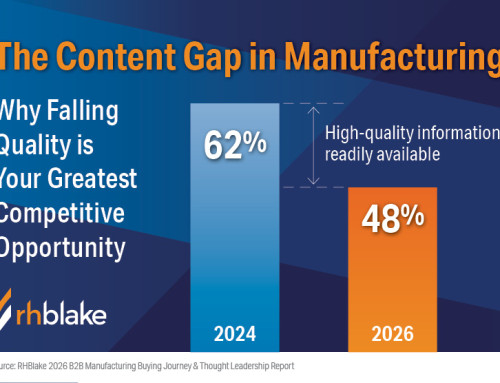
That is particularly important when the proposed solution touches an existing control environment. RHBlake’s 2026 buyer research found integration concern rose from 27% to 46%. In automation, that concern is not abstract. It can determine whether a buyer keeps evaluating a modernization program or defaults to the incumbent and the status quo.
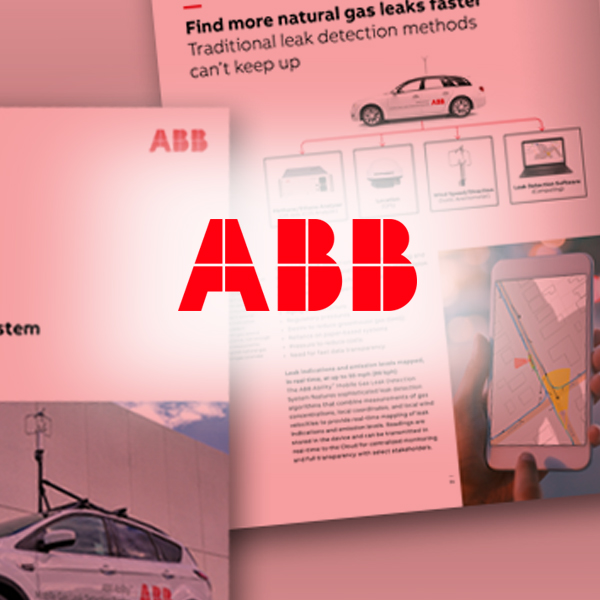
ABB provides a practical example of the kind of environment this article describes. RHBlake supports ABB on complex industrial and process-automation marketing where the buying discussion can involve control architecture, software, energy performance, operational risk, engineering stakeholders, and long sales cycles. The content has to translate technical capability into a reason to act while giving engineers enough substance to evaluate the claim.
RHBlake’s automation work makes the point tangible
What this looks like in practice
Consider a brownfield controls opportunity. The buyer may like the performance story and still stay with the incumbent because a migration threatens downtime, retraining, cybersecurity review, or standardization across plants. Marketing that ignores those practical frictions can generate interest without changing the buying decision.
Industrial automation suppliers have a better chance of getting considered when they help buyers understand the path from the installed environment to the desired operating outcome. That takes technical substance early, while the buyer is still figuring out what can change and what cannot.

"You guys met our expectations in every way. It [RH Blake Market Research] was the information we were looking for. Congratulations and Thank You!"
 Scott Griggs
Director of Services for Food Manufacturing and Food Service
ALS Global

"“I’ve gotten all that I’d hoped for from the RH Blake Growth Roadmap™ and more. Based on the research and insights, we adjusted our offering scope and sales approach. And this adjustment has been effective at generating new opportunities."
 Diane Reko
President
REKO International

"RH Blake has been an outstanding partner. They deliver creativity, on time, and always so professional. We love working with them because of their perspective, support, and their efficiency in turning projects around quickly."
 Samantha Spano
Digital Product Marketing & Communications Manager
Industrial Automation Energy Industries
ABB
"You guys met our expectations in every way. It [RH Blake Market Research] was the information we were looking for. Congratulations and Thank You!"
Scott Griggs
Director of Services for Food Manufacturing and Food Service
ALS Global
"“I’ve gotten all that I’d hoped for from the RH Blake Growth Roadmap™ and more. Based on the research and insights, we adjusted our offering scope and sales approach. And this adjustment has been effective at generating new opportunities."
Diane Reko
President
REKO International
"RH Blake has been an outstanding partner. They deliver creativity, on time, and always so professional. We love working with them because of their perspective, support, and their efficiency in turning projects around quickly."
Samantha Spano
Digital Product Marketing & Communications Manager
Industrial Automation Energy Industries
ABB
"You guys met our expectations in every way. It [RH Blake Market Research] was the information we were looking for. Congratulations and Thank You!"
Scott Griggs
Director of Services for Food Manufacturing and Food Service
ALS Global
"“I’ve gotten all that I’d hoped for from the RH Blake Growth Roadmap™ and more. Based on the research and insights, we adjusted our offering scope and sales approach. And this adjustment has been effective at generating new opportunities."
Diane Reko
President
REKO International
"RH Blake has been an outstanding partner. They deliver creativity, on time, and always so professional. We love working with them because of their perspective, support, and their efficiency in turning projects around quickly."
Samantha Spano
Digital Product Marketing & Communications Manager
Industrial Automation Energy Industries
ABB
Industrial Marketer’s Guide to Creating an Effective Marketing Program
147 pages of actionable ideas to help you create a winning marketing strategy and program
Industrial Marketer’s Guide to Creating an Effective Marketing Program
147 pages of actionable ideas to help you create a winning marketing strategy and program
Related Clients