
The Content Gap in Manufacturing: Why Falling Quality is Your Greatest Competitive Opportunity
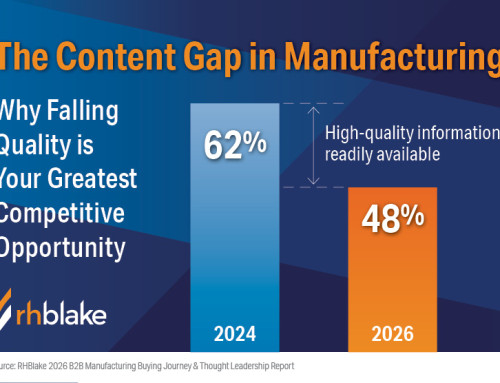
The RH Blake 2026 B2B Manufacturing Buying Journey & Thought Leadership Report identifies a critical content gap. While 90% of buyers rely on thought leadership, the percentage of buyers who say high-quality thought leadership is readily available declined from 62% in 2024 to 48% in 2026. This creates a massive opportunity for manufacturers to lead with problem-framing insights.
Buyers are increasingly self-educating incognito, with 81% establishing shortlists before vendor contact. Buying cycles have also lengthened, with 34% exceeding 12 months. Because 50% of buyers spend under two hours weekly on research, content must be highly scannable, focusing on technical proof over brand prestige.
Additionally, despite AI adoption doubling to 48%, trust remains low (4.9/10), heightening the value of human-verified data. To succeed, marketers must serve multi-persona committees and address overlooked needs, such as integration complexity, which is now a primary concern for 46% of buyers.
In the B2B manufacturing sector, the demand for expert insight has never been higher, but the perceived quality of available content isn’t keeping up. RH Blake’s 2026 2026 B2B Manufacturing Buying Journey & Thought Leadership Report found that 90% of manufacturing buyers use thought leadership in their professional roles. At the same time, the percentage who say high-quality information is readily available fell from 62% in 2024 to 48% in 2026.
Free Download: 5 Key Steps to Developing a Digital Marketing Roadmap
A Must Have Digital Marketing Guide for Manufacturers
For some marketers, this might look like a crisis of engagement. But for strategic leaders, this 14-point drop represents a market opportunity. Despite the decline in quality, 90% of buyers continue to consume thought leadership for their professional roles. There is a widening content gap where buyers want substance but they are increasingly met with generic content.
The manufacturers that choose to fill this gap with technically rigorous, problem-framing content will define the evaluation criteria for their entire category.
Why the Content Gap Matters Before Vendor Contact
The content gap becomes commercially significant when considered alongside another buyer behavior: 81% of buyers establish a supplier shortlist before contacting a vendor. They are conducting the majority of their research incognito. They are no longer waiting for a sales representative to educate them. Content is often shaping consideration before sales knows an opportunity exists.
When they do finally reach out, it is not for a standard sales pitch. In complex markets, early outreach is now consultative, with buyers seeking expert thinking on solutions they cannot find cookie-cutter answers for online.
If your content is perceived as low-quality or brand-boasting, you are losing readers. But you are also being dropped from any shortlist before you even knew the buyer is looking. This systematic disconnect is further evidenced by the fact that only 28.7% of respondents believe vendors understand their buying process very well or extremely well. When buyers don’t feel understood, they route around the vendor entirely, relying instead on peer networks and independent research.
AI-Assisted Research Raises the Standard for Proof
Use of AI for supplier research increased from 23% in 2024 to 48% in 2026, while buyers gave AI output an average trust score of 4.9 out of 10. This places greater importance on traceable evidence: named experts, transparent sources, technical specifications, case results, and clearly documented assumptions. Content should also be structured so buyers can verify individual claims quickly.
Buyers are actively seeking human-verified, technical proof points that can survive the scrutiny of AI-assisted comparisons. Manufacturers that provide precise, structured technical data will win because they provide the verifiable truth that AI currently lacks.
Thought Leadership as a Commercial Engine
The RH Blake Report demonstrates that thought leadership now shapes how buyers name and frame their problems. Thought leadership now shapes supplier consideration well before a formal buying process begins. Its use during the awareness stage increased from 68% in 2024 to 80% in 2026.
When you produce high-quality content, the commercial ramifications are measurable and significant:
- 87% of buyers think more positively about an organization with high-quality thought leadership
- 82% will contact that organization first when a need arises
- 76% of buyers say quality content directly influences their decision to invite a vendor to an RFP
In an era of lengthening buying cycles, where 34% of projects now take over 12 months to conclude, this early visibility helps suppliers remain credible during buying cycles that may extend beyond 12 months.
Defining Quality in 2026: The New Standard
If buyers are rejecting current content because of poor quality, what do they actually want? The RH Blake 2026 B2B Manufacturing Buying Journey & Thought Leadership Report provides clear direction for what constitutes quality in the eyes of senior decision-makers:
- Real-World Evidence and Technical Relevance: Real-world experiences and case studies (rated 4.41/5) and addressing relevant industry challenges (4.27/5) are the top indicators of quality. Buyers are disregarding brand boasting in favor of technical relevance.
- Addressing Integration Complexity: This is the fastest-growing buyer priority, jumping 19 percentage points from 27% to 46% year-over-year. Yet, it remains a common vendor oversight. Content that provides honest documentation of integration requirements and deployment realities fills a genuine market gap.
- Design for Limited Research Time: The window to make an impact is shrinking. 50% of buyers now spend two hours or less per week on research, a massive increase from 18.3% just two years ago. Content must lead with Too Long; Didn’t Read (TL/DR) summaries and visual data to be successful.
- Designing for the Committee: Decisions are rarely made by one person. 83% of purchases involve five or more evaluators. Quality thought leadership must speak to multiple personas, giving ROI data to Finance while providing technical specs to Engineering, and giving other members of the committee the facts they need to address their concerns around performance, economics, implementation, compatibility, risk, and support requirements.
Conclusion: From Vendor to Authoritative Consultant
Manufacturers should treat these findings as a content audit brief. Review the resources buyers encounter before speaking with sales, including application pages, technical articles, case studies, comparison content, and integration guidance. Each asset should help buyers understand the problem, evaluate fit, verify the evidence, and share the case with other committee members.
When 81% of buyers establish a shortlist before contacting a supplier, content quality affects whether sales ever sees the opportunity. The full RH Blake report provides a more detailed view of where buyer expectations have shifted and how manufacturers can respond.

"You guys met our expectations in every way. It [RH Blake Market Research] was the information we were looking for. Congratulations and Thank You!"
 Scott Griggs
Director of Services for Food Manufacturing and Food Service
ALS Global

"“I’ve gotten all that I’d hoped for from the RH Blake Growth Roadmap™ and more. Based on the research and insights, we adjusted our offering scope and sales approach. And this adjustment has been effective at generating new opportunities."
 Diane Reko
President
REKO International

"RH Blake has been an outstanding partner. They deliver creativity, on time, and always so professional. We love working with them because of their perspective, support, and their efficiency in turning projects around quickly."
 Samantha Spano
Digital Product Marketing & Communications Manager
Industrial Automation Energy Industries
ABB
"You guys met our expectations in every way. It [RH Blake Market Research] was the information we were looking for. Congratulations and Thank You!"
Scott Griggs
Director of Services for Food Manufacturing and Food Service
ALS Global
"“I’ve gotten all that I’d hoped for from the RH Blake Growth Roadmap™ and more. Based on the research and insights, we adjusted our offering scope and sales approach. And this adjustment has been effective at generating new opportunities."
Diane Reko
President
REKO International
"RH Blake has been an outstanding partner. They deliver creativity, on time, and always so professional. We love working with them because of their perspective, support, and their efficiency in turning projects around quickly."
Samantha Spano
Digital Product Marketing & Communications Manager
Industrial Automation Energy Industries
ABB
"You guys met our expectations in every way. It [RH Blake Market Research] was the information we were looking for. Congratulations and Thank You!"
Scott Griggs
Director of Services for Food Manufacturing and Food Service
ALS Global
"“I’ve gotten all that I’d hoped for from the RH Blake Growth Roadmap™ and more. Based on the research and insights, we adjusted our offering scope and sales approach. And this adjustment has been effective at generating new opportunities."
Diane Reko
President
REKO International
"RH Blake has been an outstanding partner. They deliver creativity, on time, and always so professional. We love working with them because of their perspective, support, and their efficiency in turning projects around quickly."
Samantha Spano
Digital Product Marketing & Communications Manager
Industrial Automation Energy Industries
ABB
Industrial Marketer’s Guide to Creating an Effective Marketing Program
147 pages of actionable ideas to help you create a winning marketing strategy and program
Industrial Marketer’s Guide to Creating an Effective Marketing Program
147 pages of actionable ideas to help you create a winning marketing strategy and program
Related Clients