
How to Create Content for the Modern Manufacturing Buying Committee
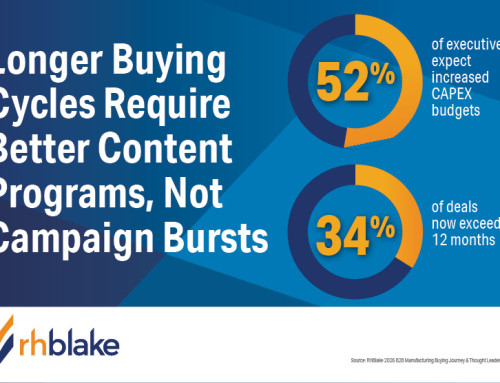
Industrial buying decisions in 2026 are rarely made by a single person. According to RH Blake’s 2026 B2B Manufacturing Buying Journey & Thought Leadership Report, 58% of purchases involve five or more evaluators, with nearly 20% involving more than nine. As buying committees have grown to include engineering, finance, IT, and operations stakeholders, a content gap has opened up for manufacturers still writing primarily for the technical buyer. Closing that gap means mapping content to the specific concerns that each committee member is trying to resolve: TCO frameworks for Finance, integration guides for IT, post-sale support details for Operations, and application-specific case studies for Engineers. Ground everything in real data and customer proof. Manufacturers who build content that serves the full committee will show up on more shortlists, earn more RFP invitations, and give their prospects the tools they need to make a confident decision.
——
Something significant has shifted in how industrial manufacturers make purchasing decisions, and leveraging this shift changes how you approach your entire content strategy.
According to RH Blake’s 2026 B2B Manufacturing Buying Journey & Thought Leadership Report, roughly 58% of industrial purchases now involve five or more evaluators. Nearly 20% involve more than nine people. The individual technical champion who once carried a recommendation upstairs and got a quick approval is increasingly rare. Buying committees have become the norm in industrial markets, and this creates both a challenge and a real opportunity for manufacturers who are willing to think carefully about who their content is actually serving.
Free Download: 5 Key Steps to Developing a Digital Marketing Roadmap
A Must Have Digital Marketing Guide for Manufacturers
How the Committee Forms
Consider what happens inside a manufacturing organization when a significant capital purchase gets triggered. These days, the triggers tend to be urgent and specific: aging assets that need replacement, regulatory compliance deadlines, capacity expansion needs, safety concerns. When one of these events fires, the buying process rarely stays within a single function for long:
- An engineer identifies the technical need
- A finance manager gets pulled in to evaluate total cost of ownership
- IT wants to understand integration requirements and cybersecurity implications
- Operations is thinking about installation downtime and long-term service support
Each of these people has legitimate questions, and each of them is going to go looking for answers.
Where do they look first? Your website.
The RH Blake data shows that vendor websites are the first research source for 37% of buyers and remain in use by 83% of buyers throughout their entire journey. Your website functions as a multi-persona sales environment long before any sales conversation begins. The question worth asking is whether the content there is genuinely useful to everyone who’s going to visit it, not just the engineer who initiated the search.
What Happens When Content Serves Only One Persona
Most industrial manufacturer websites are built with the technical buyer in mind. That makes sense historically because engineers have traditionally driven vendor selection in this market. But as buying committees have grown, a content gap has opened up that’s worth closing.
Picture a realistic scenario. Let’s say your company makes industrial automation equipment. Your website has detailed technical specs, application notes, and solid case studies. The content is accurate and technically credible. Now the CFO’s office asks the VP of Finance to weigh in on the capital expenditure. She visits your website looking for something she can use to build a business case, but finds motor torque curves and ingress protection ratings.
She moves on.
Or consider the IT director who’s been asked to evaluate whether your platform integrates with the company’s existing MES and ERP systems. He wants to understand APIs, protocols, cybersecurity certifications, and what an integration project looks like in practice. If all he finds is a brief mention that your system “integrates seamlessly with leading industrial platforms,” he’s left to draw his own conclusions, and uncertainty rarely favors the vendor.
Meanwhile, a competitor has published a detailed integration guide that addresses exactly the kind of legacy environment your prospect is running, names the common friction points, and explains how they’re resolved. That competitor just answered the IT director’s unasked question. That’s how shortlists get built before a sales call ever happens.
A Practical Framework: Segment by Role
The RH Blake report recommends mapping content assets to specific personas rather than producing broad content that tries to speak to everyone at once. Your goal is to help a group of evaluators with different risks, priorities and definitions of success reach a shared level of confidence. Here’s what this looks like for the four roles that appear most consistently in industrial buying committees:
The Engineer remains essential to win, and technical depth still matters. But the most useful content for engineers in 2026 is highly specific: application-specific case studies that match their operational context, honest information about installation and commissioning, integration details, and real performance data from comparable environments. The closer the match to their situation, the more useful the content becomes.
The Finance Stakeholder isn’t trying to master the technology. She’s trying to justify the investment and defend it to a capital committee. What she needs is a total cost of ownership framework that walks through acquisition, installation, training, maintenance, energy consumption, and end-of-life considerations. ROI models with realistic, verifiable assumptions. Payback period examples drawn from actual customer experience. Providing these tools makes her job easier and positions your company as a partner in building the business case rather than just a vendor waiting for a decision.
The IT and OT Stakeholder has quietly become one of the most influential voices on the buying committee (and one of the most underserved by industrial vendor content). Integration complexity is now the fastest-growing concern among industrial buyers, jumping 19 percentage points year-over-year in the RH Blake data. Detailed, honest integration guides address a genuine market gap.
- What protocols does your system support?
- What does a brownfield installation actually require?
- What are the cybersecurity certifications?
- What does the data architecture look like?
Making this content findable during the anonymous research phase, before anyone has raised their hand to talk to sales, goes a long way toward building early and shared confidence with everyone on the buying committee.
The Operations Leader carries a particular kind of risk in any capital purchase decision. If the implementation creates extended downtime, if service response is slow, if the reality of operating the new system doesn’t match the promise, that lands on operations. Content that speaks directly to post-sale support structures, service contract terms, and implementation realities resonates with this audience in a way that product-focused content simply doesn’t. Real testimonials from other operations leaders who’ve been through the process carry particular weight here.
What to Say, and When to Say It
The report’s “What to say” framework translates directly into a content architecture that serves the full committee across the buying journey:
Problem-framing and trigger content should anchor your awareness-stage strategy. Before buyers can evaluate solutions, they need to clearly recognize and articulate their problem. Content that names common challenges, such as aging infrastructure, compliance timelines, and capacity gaps, in the language your customers use helps buyers frame their thinking. There’s a compounding benefit here, too. Buyers who learn to describe their problem using your vocabulary are more likely to recognize your solution when they reach the consideration stage.
Application-specific case studies consistently rank as the highest-value content asset in industrial markets. The RH Blake data rates real-world experience and case studies at 4.41 out of 5 for thought leadership quality, the top score among all characteristics measured. Specificity is what makes them work: same industry, similar equipment, comparable operational context. Leading with the measurable outcome and then explaining how it was achieved gives readers the proof they need in a format that’s easy to share with other committee members.
TCO and lifecycle cost frameworks serve the finance function directly but help the entire committee develop a shared understanding of value. Calculators, cost models, and payback period examples that prospects can actually use (with visible, adjustable assumptions) make your company a resource rather than just a vendor.
Integration complexity guides address one of the most significant content gaps in industrial marketing right now. Buyers say vendors routinely overlook integration requirements and pricing transparency. Publishing honest, detailed guidance on what integration actually entails, including the challenges and how they’re managed, creates immediate differentiation from competitors who rely on vague assurances.
Real data and research findings build credibility that general claims cannot. Buyers consistently rate unbiased, research-grounded content as the most trustworthy. If you conduct customer surveys or have operational performance data from installations, putting that data to work in your content strengthens every claim you make.
Safety, compliance, and sustainability content has moved from supplementary to essential. Safety and risk management jumped 32 percentage points as a purchase trigger between 2025 and 2026. Regulatory compliance jumped 27 points. Content that directly addresses these triggers meets buyers at the moment they’ve decided they need to act, which is exactly where you want to be.
Honest post-sale and support content is rare enough in industrial markets that it genuinely differentiates. Buyers want to understand what happens after the purchase order. Writing about it plainly, whether support structures, service terms, or what a typical implementation looks like, builds the kind of trust that moves a company from the longlist to the shortlist.
Find the Opportunity in the Gap
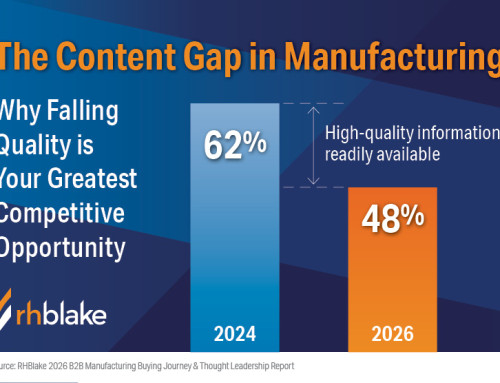
Here’s the encouraging part of the RH Blake data: perceived thought leadership quality in industrial markets has dropped from 62% to 48% over just two years, even as 90% of buyers continue actively consuming it for their professional roles. Buyers want better content than they’re currently finding. Demand is high and genuinely useful supply is lagging.
That’s a real opening for manufacturers willing to invest in content that serves the full buying committee. Not by producing more content, but by producing more deliberately targeted content, that is, content mapped to the specific questions each committee member is trying to answer, delivered in formats they can find, absorb quickly, and share with their colleagues.
The buying committee is already in the room. Building content that speaks to everyone around the table is one of the more practical steps a B2B manufacturer can take to improve how the buying journey goes, for their customers and for themselves.
If your content still leans heavily toward one buyer, we can help you see where the committee may be losing confidence before sales ever gets involved. Reach out and let’s talk.

"You guys met our expectations in every way. It [RH Blake Market Research] was the information we were looking for. Congratulations and Thank You!"
 Scott Griggs
Director of Services for Food Manufacturing and Food Service
ALS Global

"“I’ve gotten all that I’d hoped for from the RH Blake Growth Roadmap™ and more. Based on the research and insights, we adjusted our offering scope and sales approach. And this adjustment has been effective at generating new opportunities."
 Diane Reko
President
REKO International

"RH Blake has been an outstanding partner. They deliver creativity, on time, and always so professional. We love working with them because of their perspective, support, and their efficiency in turning projects around quickly."
 Samantha Spano
Digital Product Marketing & Communications Manager
Industrial Automation Energy Industries
ABB
"You guys met our expectations in every way. It [RH Blake Market Research] was the information we were looking for. Congratulations and Thank You!"
Scott Griggs
Director of Services for Food Manufacturing and Food Service
ALS Global
"“I’ve gotten all that I’d hoped for from the RH Blake Growth Roadmap™ and more. Based on the research and insights, we adjusted our offering scope and sales approach. And this adjustment has been effective at generating new opportunities."
Diane Reko
President
REKO International
"RH Blake has been an outstanding partner. They deliver creativity, on time, and always so professional. We love working with them because of their perspective, support, and their efficiency in turning projects around quickly."
Samantha Spano
Digital Product Marketing & Communications Manager
Industrial Automation Energy Industries
ABB
"You guys met our expectations in every way. It [RH Blake Market Research] was the information we were looking for. Congratulations and Thank You!"
Scott Griggs
Director of Services for Food Manufacturing and Food Service
ALS Global
"“I’ve gotten all that I’d hoped for from the RH Blake Growth Roadmap™ and more. Based on the research and insights, we adjusted our offering scope and sales approach. And this adjustment has been effective at generating new opportunities."
Diane Reko
President
REKO International
"RH Blake has been an outstanding partner. They deliver creativity, on time, and always so professional. We love working with them because of their perspective, support, and their efficiency in turning projects around quickly."
Samantha Spano
Digital Product Marketing & Communications Manager
Industrial Automation Energy Industries
ABB
Industrial Marketer’s Guide to Creating an Effective Marketing Program
147 pages of actionable ideas to help you create a winning marketing strategy and program
Industrial Marketer’s Guide to Creating an Effective Marketing Program
147 pages of actionable ideas to help you create a winning marketing strategy and program
Related Clients