
How Industrial Buyers Research Suppliers Before Contacting Sales
The buyer can be deep into the process before a lead exists
Industrial companies often see the first form submission, email, or sales call as the start of an opportunity. The buyer may see it as the middle. Before contacting a vendor, engineers and other stakeholders can spend weeks or months defining the problem, researching technologies, identifying potential suppliers, comparing approaches, and deciding what questions to ask.
That invisible period is where a large share of marketing’s work occurs. A supplier that is absent, vague, or difficult to evaluate may be eliminated without ever knowing an opportunity existed.
Your website is where many buyers decide whether to keep looking
RHBlake’s 2026 study found that 85% of buyers use supplier websites, more than any other research source measured. That changes what ‘conversion’ means for a manufacturing website. A visitor who finds the right technical answer, understands where a product fits, and comes back two weeks later may be progressing even if no form was submitted on the first visit.
The most useful sites make applications easy to understand, explain technical fit, expose useful documentation, show credible examples, surface relevant expertise, and give the buyer a logical next step. The site should also recognize that not every visitor is ready for a conversation. A design guide, case history, comparison page, application note, or research report may be a more appropriate next step than ‘request a quote.’
Free Download: 5 Key Steps to Developing a Digital Marketing Roadmap
A Must Have Digital Marketing Guide for Manufacturers
Expect buyers to verify what you say
64% of buyers use independent sources and 45% rely on peer recommendations. Supplier content therefore exists inside a broader credibility system. Buyers may read trade media, association material, analyst coverage, forums, partner content, distributor pages, peer commentary, and competitor sites before deciding what to believe.
This is one reason earned media, third-party citations, contributed technical articles, conference participation, and strong customer examples remain relevant even when the website is the primary owned channel. They give buyers evidence outside the supplier’s own claims.
Thin technical content is an easy reason to leave
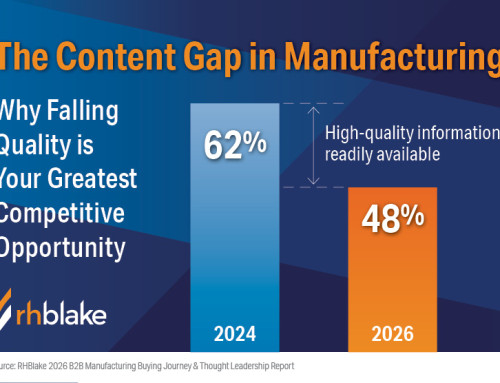
About one-third of buyers identify insufficient technical specificity or differentiation as a weakness in supplier information. This is a practical warning for B2B marketers who simplify technical content until every competitor sounds interchangeable.
A buyer evaluating a semiconductor, industrial control platform, specialty material, medical device component, or engineered system wants enough detail to determine whether further investigation is warranted. Marketing does not need to reproduce the manual on every page, but it does need to answer the questions that separate a plausible supplier from a generic one.
Triggers shape what buyers search for
The leading research triggers in RHBlake’s latest study were aging assets, compliance, capacity growth, and technology advances. Those triggers shape search behavior. An operations team may begin with ‘replace obsolete control system,’ a compliance requirement, or a capacity constraint rather than the category name a supplier uses internally.
Content strategy should therefore include the problem language buyers use before they know exactly which product or supplier category they need. That is where thought leadership, technical education, and search content can shape the eventual shortlist.
A first conversation does not mean the research is over
76% of buyers contact a vendor before the halfway point, which means sales still has substantial influence. The lesson is not that buyers want a completely self-service purchase. It is that the conversation is more productive when the supplier has already earned enough confidence to be contacted.
Marketing and sales should use the same evidence. The content that helps an anonymous buyer understand integration, performance, risk, and proof should also help a salesperson advance an active opportunity. That creates continuity instead of handing a buyer from one narrative to another.
The common thread is that research was used to decide what the market needed to hear and where the company needed to become easier to find. It was not treated as a presentation that sat beside the marketing program.
RHBlake’s work with Factivity and Caster Connection shows two ways buyer evidence can alter marketing decisions. For Factivity, understanding how manufacturing buyers searched and evaluated software informed the SEO and content system that RHBlake says ultimately produced more than 50% organic-traffic growth and 815% cumulative lead growth. For Caster Connection, voice-of-customer work helped identify market opportunities, sharpen application-specific positioning, and support new product and market initiatives.
Buyer research becomes more valuable when it changes the work
What this looks like in practice
One implication for supplier websites is easy to miss: a visitor may arrive through a very narrow technical question and never see the homepage. Application pages, technical articles, comparison content, and case histories therefore need enough context to qualify the company on their own. The buyer should not have to reconstruct the supplier’s credibility from five unrelated pages.
By the time sales sees the first signal, an industrial buyer may already have ruled out several suppliers. Marketing should make that early research easier, give the buyer enough evidence to keep RHBlake’s client in consideration, and leave fewer basic questions for the first sales conversation.

"You guys met our expectations in every way. It [RH Blake Market Research] was the information we were looking for. Congratulations and Thank You!"
 Scott Griggs
Director of Services for Food Manufacturing and Food Service
ALS Global

"“I’ve gotten all that I’d hoped for from the RH Blake Growth Roadmap™ and more. Based on the research and insights, we adjusted our offering scope and sales approach. And this adjustment has been effective at generating new opportunities."
 Diane Reko
President
REKO International

"RH Blake has been an outstanding partner. They deliver creativity, on time, and always so professional. We love working with them because of their perspective, support, and their efficiency in turning projects around quickly."
 Samantha Spano
Digital Product Marketing & Communications Manager
Industrial Automation Energy Industries
ABB
"You guys met our expectations in every way. It [RH Blake Market Research] was the information we were looking for. Congratulations and Thank You!"
Scott Griggs
Director of Services for Food Manufacturing and Food Service
ALS Global
"“I’ve gotten all that I’d hoped for from the RH Blake Growth Roadmap™ and more. Based on the research and insights, we adjusted our offering scope and sales approach. And this adjustment has been effective at generating new opportunities."
Diane Reko
President
REKO International
"RH Blake has been an outstanding partner. They deliver creativity, on time, and always so professional. We love working with them because of their perspective, support, and their efficiency in turning projects around quickly."
Samantha Spano
Digital Product Marketing & Communications Manager
Industrial Automation Energy Industries
ABB
"You guys met our expectations in every way. It [RH Blake Market Research] was the information we were looking for. Congratulations and Thank You!"
Scott Griggs
Director of Services for Food Manufacturing and Food Service
ALS Global
"“I’ve gotten all that I’d hoped for from the RH Blake Growth Roadmap™ and more. Based on the research and insights, we adjusted our offering scope and sales approach. And this adjustment has been effective at generating new opportunities."
Diane Reko
President
REKO International
"RH Blake has been an outstanding partner. They deliver creativity, on time, and always so professional. We love working with them because of their perspective, support, and their efficiency in turning projects around quickly."
Samantha Spano
Digital Product Marketing & Communications Manager
Industrial Automation Energy Industries
ABB
Industrial Marketer’s Guide to Creating an Effective Marketing Program
147 pages of actionable ideas to help you create a winning marketing strategy and program
Industrial Marketer’s Guide to Creating an Effective Marketing Program
147 pages of actionable ideas to help you create a winning marketing strategy and program
Related Clients