
Manufacturing Marketing Strategy for Long, Complex Buying Journeys
The opportunity exists long before the RFQ
An RFQ is a visible event. The commercial opportunity usually begins much earlier. A plant is living with aging equipment, an OEM is planning a new platform, a manufacturer is confronting a compliance requirement, or engineering is testing whether an existing architecture can support the next phase of growth. Marketing strategy has to be present while those questions are forming.
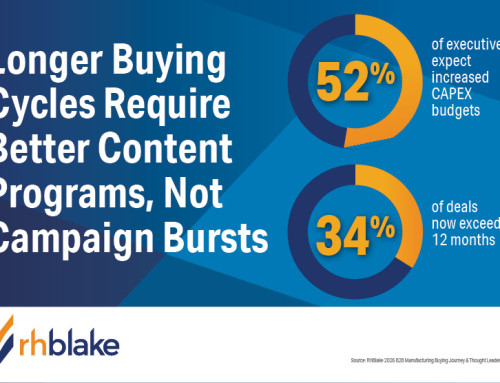
RHBlake’s 2026 research reinforces that point. Aging assets, compliance, capacity growth, and technology advances were the leading triggers buyers identified. A strategy built only around active search demand enters the journey late and competes after buyers have already formed preferences.
The supplier website is part of the sales process
RHBlake’s 2026 research found that 85% of buyers use supplier websites during research. In practice, that means the website is often doing qualification work before sales knows an opportunity exists. About one-third of buyers also point to weak technical specificity or differentiation as a problem in supplier information. A polished site with thin substance can lose a technically serious buyer very quickly.
For complex products, the path to conversion runs through practical questions: Where does this fit? What operating conditions matter? What will it integrate with? What does implementation look like? What happens five years from now? A generic contact form is useful only after the site has done enough work to make contact feel worthwhile.
Free Download: 5 Key Steps to Developing a Digital Marketing Roadmap
A Must Have Digital Marketing Guide for Manufacturers
Follow the decision, not a generic persona chart
A technically credible message can still fail if it only serves engineering. Operations may worry about disruption. Procurement may question supply continuity. Finance may want the economics. Quality may require documentation. IT and cybersecurity may enter when equipment or software connects to broader systems. The content program should anticipate how the decision changes as more people enter.
This is where persona exercises often become too shallow. Demographics matter less than decision responsibility. Identify who defines the problem, who evaluates the technical solution, who can stop the project, who controls budget, and who must defend the choice internally.
Address the risk buyers are actually carrying
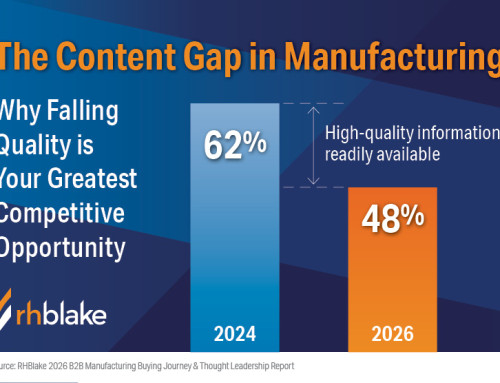
Concern about integration with existing systems rose from 27% in 2025 to 46% in RHBlake’s 2026 study. That is a powerful signal for manufacturers selling anything that has to work inside an installed environment. Compatibility guides, migration plans, reference architectures, commissioning methodology, service coverage, lifecycle commitments, and implementation case histories can all function as demand-generation assets because they reduce uncertainty.
A manufacturer may prefer to talk about performance leadership. The buyer may be more concerned about whether installation will shut down production for two days. Strategy should make room for both realities.
Earn familiarity while the project is still taking shape
RHBlake’s thought-leadership research found that 90% of manufacturing buyers say strong thought leadership affects supplier trust and 88% say it makes them more receptive to sales outreach. That makes thought leadership useful upstream, where the goal is to shape how buyers understand a problem before they are comparing vendors.
The useful subjects are rarely generic trend recaps. Stronger pieces quantify an emerging issue, explain a technical tradeoff, challenge an accepted assumption, show how a market is changing, or give a buyer a better way to evaluate alternatives. That is the kind of content a salesperson can also use later in an active opportunity.
Concentrate the strategy where growth actually matters
A strategy should create concentration. Pick the markets, applications, buying triggers, offers, and accounts that matter most. Then decide what search visibility, content, paid media, trade media, events, account-based programs, and sales tools are required to support those priorities.
This prevents the common pattern of distributing a modest budget across too many markets and channels. In specialized manufacturing, relevance often matters more than reach. A small number of technically credible assets used consistently across search, sales, PR, and account outreach can create more commercial value than a high-volume publishing calendar.
Caster Connection faced a different strategic problem: growth required moving beyond commodity perceptions and finding stronger application and market opportunities. RHBlake used voice-of-customer research and its Growth Roadmap process to sharpen positioning, support new-market entry, and bring application-specific offers to market. In both cases, the work began with choices about where the company could win before channels or campaigns were selected.
MCA Connect illustrates the difference between promoting capabilities and changing how a technical company is understood. RHBlake helped reposition the Microsoft-focused integrator as a strategic manufacturing thought leader, using manufacturing-specific messaging, content, and product-launch support to make its expertise more legible to the market.
What strategic repositioning can change
What this looks like in practice
A useful test is to sit with a salesperson and walk through a real opportunity that took six or twelve months to close. Where did the buyer first learn about the company? What did engineering need before the first meeting? Which objection slowed the deal? Which internal stakeholder appeared late? The strategy should account for those moments instead of assuming a tidy funnel.
Manufacturing strategy gets clearer when the team starts with the market, the buying problem, and the evidence required to make a change feel safe. Channels and tactics follow from those choices. That sequence also makes it easier to explain why a program deserves budget and how it is expected to help sales.

"You guys met our expectations in every way. It [RH Blake Market Research] was the information we were looking for. Congratulations and Thank You!"
 Scott Griggs
Director of Services for Food Manufacturing and Food Service
ALS Global

"“I’ve gotten all that I’d hoped for from the RH Blake Growth Roadmap™ and more. Based on the research and insights, we adjusted our offering scope and sales approach. And this adjustment has been effective at generating new opportunities."
 Diane Reko
President
REKO International

"RH Blake has been an outstanding partner. They deliver creativity, on time, and always so professional. We love working with them because of their perspective, support, and their efficiency in turning projects around quickly."
 Samantha Spano
Digital Product Marketing & Communications Manager
Industrial Automation Energy Industries
ABB
"You guys met our expectations in every way. It [RH Blake Market Research] was the information we were looking for. Congratulations and Thank You!"
Scott Griggs
Director of Services for Food Manufacturing and Food Service
ALS Global
"“I’ve gotten all that I’d hoped for from the RH Blake Growth Roadmap™ and more. Based on the research and insights, we adjusted our offering scope and sales approach. And this adjustment has been effective at generating new opportunities."
Diane Reko
President
REKO International
"RH Blake has been an outstanding partner. They deliver creativity, on time, and always so professional. We love working with them because of their perspective, support, and their efficiency in turning projects around quickly."
Samantha Spano
Digital Product Marketing & Communications Manager
Industrial Automation Energy Industries
ABB
"You guys met our expectations in every way. It [RH Blake Market Research] was the information we were looking for. Congratulations and Thank You!"
Scott Griggs
Director of Services for Food Manufacturing and Food Service
ALS Global
"“I’ve gotten all that I’d hoped for from the RH Blake Growth Roadmap™ and more. Based on the research and insights, we adjusted our offering scope and sales approach. And this adjustment has been effective at generating new opportunities."
Diane Reko
President
REKO International
"RH Blake has been an outstanding partner. They deliver creativity, on time, and always so professional. We love working with them because of their perspective, support, and their efficiency in turning projects around quickly."
Samantha Spano
Digital Product Marketing & Communications Manager
Industrial Automation Energy Industries
ABB
Industrial Marketer’s Guide to Creating an Effective Marketing Program
147 pages of actionable ideas to help you create a winning marketing strategy and program
Industrial Marketer’s Guide to Creating an Effective Marketing Program
147 pages of actionable ideas to help you create a winning marketing strategy and program
Related Clients