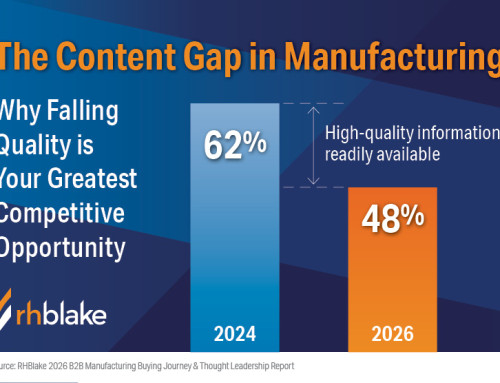

What B2B Manufacturing Buyers Want from Your Thought Leadership
In a business environment flooded with information, content that helps your customers and prospects learn something new and valuable is essential for cutting through the noise and improving business outcomes. This is especially true in the complex B2B manufacturing ecosystem, where purchases are often high-value and technical, with long sales cycles.
The rise of generative AI has exacerbated the information overload, making it possible for marketers to flood the zone with high-volume, low-effort material. While the natural instinct may be to produce more content, the answer for sophisticated B2B purchases is greater quality and differentiation.
RH Blake’s research, based on surveying manufacturing executives and managers involved in making complex purchase decisions, confirms that while thought leadership is highly valued—90% of decision-makers are more likely to consider buying from an organization that produces it—buyers have increasingly high standards. They are looking for content based on real experiences, relevance and an unbiased perspective.
We found that B2B manufacturing buyers demand three things above all else from thought leadership content:
- Deep technical expertise & distinction in application areas.
- Objective credibility & trust built through independent validation.
- Strategic value focusing on reliability, total cost of ownership, and C-Suite concerns.
Free Download: 5 Key Steps to Developing a Digital Marketing Roadmap
A Must Have Digital Marketing Guide for Manufacturers
Why This Matters Now More Than Ever
The landscape for complex B2B manufacturing purchases is undergoing a rapid transformation, characterized by more stakeholders, tighter budgets, and a fragmented buyer’s journey. These factors amplify the need for high-quality thought leadership.
Buyers are self-educating incognito
Your website is the #1 research destination for 85% of respondents, with search engines often being the very first contact point. Buyers are well into their research before initiating direct contact, with only 19% reaching out during the initial 10% of their journey. This highlights a long period of unassisted research where high-quality content must do the heavy lifting.
Your C-Suite is highly influential
While marketers often focus on the direct buying audience (like engineers), C-level executives have a significant or major influence on the final purchasing decision for complex solutions. Seventy-eight percent of buyers feel the C-level is highly or extremely influential in decisions. Thought leadership must therefore address the strategic concerns of this audience segment.
The AI content flood is real, but trust is low
While generative AI tools are emerging, trust in AI-generated information is low. Buyers currently place only moderate trust in AI-generated information for major buying decisions, with an average trust level of 4.5 out of 10. This increases the demand for human-verified, expert-driven content.
Executives Want Expertise, Credibility and Strategic Value
1. Deep technical expertise and differentiation
Thought leadership must go beyond generic concepts. Your buyers are scrutinizing vendors for application-specific expertise more than anything else.
When assessing vendors, demonstrable technical and industry-specific expertise is prioritized over general brand recognition, awards, or sponsorships. In fact, buyers rated expertise in their specific application area as the most important factor in assessing technical credibility (4.43 out of 5). Furthermore, 33% of buyers felt vendors often lack sufficient technical depth and clear product differentiation. This highlights a critical gap: vendors are failing to clearly articulate what makes their offering uniquely superior to competitors’. The most effective thought leadership is based on real-world experiences, case studies, and examples, as 93% of decision-makers rate this as important or very important.
Your takeaway: Focus on developing and showcasing content that highlights your deep, specific expertise in your target customers’ applications and industries. Ensure your messaging clearly articulates your product’s unique value proposition and differentiation points, moving beyond generic features to highlight specific competitive advantages.
2. Objective credibility and trust
Trust is paramount in high-value manufacturing purchases, and it is often built via people-to-people interactions and established channels.
A significant majority of buyers (64%) regularly seek independent, objective sources of information that are not sponsored by a vendor or distributor. This demonstrates a strong desire for unbiased truth and a need to verify vendor claims through neutral channels. While vendor websites are the primary research tool (85%), buyers highly value peer recommendations (45%) and sales/application engineers (44%). The single strongest indicator of a supplier’s credibility is recommendations/references from past customers, outweighing factors like thought leadership presence or awards. Buyers also spend their time reviewing thought leadership; 39% of decision-makers spend more than 6 hours a week reviewing thought leadership content. This time investment often leads to action, with 87% saying thought leadership led them to research a product or service they were not previously considering.
Your takeaway: Invest in cultivating trust by contributing to independent industry platforms, such as publishing articles in reputable trade publications. Actively ensure client satisfaction and systematically solicit recommendations and references from past customers, as these are invaluable assets for building credibility.
3. Strategic value: reliability, total cost of ownership, and C-suite focus
Effective thought leadership must align with the primary pain points that compel action and address the long-term concerns of the influential executive audience.
Critical operational needs, such as asset aging (59%) and technology obsolescence (52%), are the primary drivers for initiating major purchasing processes. Marketers must lead with problem-centric messaging, focusing early-stage content on how solutions alleviate pain points related to outdated technology or insufficient capacity. When evaluating vendors for large purchases, the buyers’ top concerns are reliability, total cost of ownership (TCO), and support. These factors often outweigh brand reputation. The marketing content must therefore speak to the strategic concerns of C-level executives—such as return on investment, risk mitigation, and long-term business goals—rather than just technical specifications.
Your takeaway: Develop marketing content that speaks to the strategic concerns of C-level executives and emphasizes reliability, lifecycle costs, and robust support. Focus your messaging on the operational urgency (asset aging, obsolescence) that triggers the buying journey, understanding that cost savings are often secondary benefits rather than initial triggers.
The Cost of Falling Short
In the complex manufacturing environment, poor thought leadership doesn’t just fail to generate leads—it actively hurts your reputation.
- If you miss on Technical Expertise, you look like a generalist, and the buyer assumes a deficit in depth.
- If you miss on Objective Credibility, you appear self-promotional, risking dismissal by the 64% of buyers actively seeking impartial sources.
- If you miss on Strategic Value, you risk being overlooked by the influential C-suite, who prioritize reliability and TCO over mere technical specifications.
The trifecta of expertise, credibility and strategic value has always mattered. But in an era of deep buyer self-education, AI-fueled noise, and heightened skepticism, they’ve moved from important to indispensable. Successful marketers must blend diverse strategies—from digital content and SEO to expert engagement and tailored executive messaging—to truly satisfy the complex appetite of today’s B2B buyer.
FAQ: What B2B Manufacturing Buyers Want from Thought Leadership
Q: What are the primary triggers that start a complex manufacturing purchase?
A: Critical operational needs, such as asset aging or replacement needs (59% of respondents) and technology obsolescence/advances (52%), are the primary drivers for initiating a major purchasing process.
Q: What is the single most important factor for assessing a vendor’s technical credibility?
A: Demonstrable expertise in the buyer’s specific application area is prioritized above all other factors, including certifications and general thought leadership reputation.
Q: How influential are C-level executives in complex B2B manufacturing decisions?
A: C-level executives are highly influential, with 78% of buyers stating they have a highly or extremely influential role in the final decision.
Q: What should thought leadership emphasize to appeal to the C-suite?
A: Messaging should address strategic concerns such as reliability, total cost of ownership (TCO), operational efficiency, and risk mitigation, rather than purely technical details. Reliability, TCO, and support terms are the top concerns when evaluating vendors for large purchases.
Q: How often do manufacturing buyers seek independent information? A: A significant 64% of buyers actively seek independent, objective information that is not sponsored by a vendor or distributor when conducting research.
Q: How much trust do buyers place in AI-generated content?
A: Buyers currently place moderate trust in AI-generated information for major buying decisions, with an average trust level of 4.5 out of 10.
Q: How long does the average B2B manufacturing buyer spend reviewing thought leadership?
A: 39% of decision-makers spend more than 6 hours a week reviewing thought leadership content.
Q: How important is thought leadership to market position?
A: 92% of decision-makers think more positively of organizations that consistently produce thought leadership content, and 90% say it increases trust in existing or potential suppliers. Good thought leadership can even allow organizations to charge a premium, as 76% of decision-makers are more likely to pay a premium to work with a thought leader.
Your Strategic Imperative
The B2B manufacturing buying journey is highly complex, characterized by extensive self-education, a multi-stakeholder decision-making unit, and a crucial blend of digital and traditional information sources. For you as a marketer, success hinges on achieving resonance and trust, meaning your thought leadership must prioritize technical depth, as expertise in a specific application area is the most important factor buyers use to assess credibility.
To cut through the increasing noise and skepticism, content must be objective (as 64% of buyers actively seek independent sources), clearly articulate product differentiation (since 33% feel vendors often lack sufficient depth), and strategically address executive concerns like reliability and Total Cost of Ownership (TCO). Organizations that successfully blend strategies—from digital content and SEO to expert engagement and tailored executive messaging—not only satisfy the complex appetite of the modern B2B buyer but are also rewarded, as 76% of decision-makers are more likely to pay a premium to work with an organization that produces high-quality thought leadership.
The complex, high-value B2B manufacturing purchase journey presents both challenges and opportunities for marketers. Contact RH Blake today to ensure your thought leadership strategy drives targeted awareness, preference, and margin expansion by meeting the high standards of B2B manufacturing buyers.

"You guys met our expectations in every way. It [RH Blake Market Research] was the information we were looking for. Congratulations and Thank You!"
 Scott Griggs
Director of Services for Food Manufacturing and Food Service
ALS Global

"“I’ve gotten all that I’d hoped for from the RH Blake Growth Roadmap™ and more. Based on the research and insights, we adjusted our offering scope and sales approach. And this adjustment has been effective at generating new opportunities."
 Diane Reko
President
REKO International

"RH Blake has been an outstanding partner. They deliver creativity, on time, and always so professional. We love working with them because of their perspective, support, and their efficiency in turning projects around quickly."
 Samantha Spano
Digital Product Marketing & Communications Manager
Industrial Automation Energy Industries
ABB
"You guys met our expectations in every way. It [RH Blake Market Research] was the information we were looking for. Congratulations and Thank You!"
Scott Griggs
Director of Services for Food Manufacturing and Food Service
ALS Global
"“I’ve gotten all that I’d hoped for from the RH Blake Growth Roadmap™ and more. Based on the research and insights, we adjusted our offering scope and sales approach. And this adjustment has been effective at generating new opportunities."
Diane Reko
President
REKO International
"RH Blake has been an outstanding partner. They deliver creativity, on time, and always so professional. We love working with them because of their perspective, support, and their efficiency in turning projects around quickly."
Samantha Spano
Digital Product Marketing & Communications Manager
Industrial Automation Energy Industries
ABB
"You guys met our expectations in every way. It [RH Blake Market Research] was the information we were looking for. Congratulations and Thank You!"
Scott Griggs
Director of Services for Food Manufacturing and Food Service
ALS Global
"“I’ve gotten all that I’d hoped for from the RH Blake Growth Roadmap™ and more. Based on the research and insights, we adjusted our offering scope and sales approach. And this adjustment has been effective at generating new opportunities."
Diane Reko
President
REKO International
"RH Blake has been an outstanding partner. They deliver creativity, on time, and always so professional. We love working with them because of their perspective, support, and their efficiency in turning projects around quickly."
Samantha Spano
Digital Product Marketing & Communications Manager
Industrial Automation Energy Industries
ABB
Industrial Marketer’s Guide to Creating an Effective Marketing Program
147 pages of actionable ideas to help you create a winning marketing strategy and program
Industrial Marketer’s Guide to Creating an Effective Marketing Program
147 pages of actionable ideas to help you create a winning marketing strategy and program
Related Clients